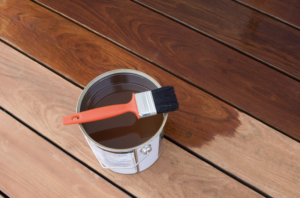
 When it comes to deck painting vs. staining, the short answer is: stain is usually the better call for a deck that’s still in decent structural shape, and paint makes more sense for an older deck where you’re trying to hide wear rather than show off the wood grain. But “usually” isn’t “always,” and the right answer really depends on the age and condition of the wood you’re starting with.
Affordable Painting & More gets this question constantly heading into deck season, so here’s how Mike actually walks through it with homeowners.
Deck Painting vs. Staining: The Real Tradeoffs
Stain
- Lets the wood grain show through, which most people prefer on a deck versus a fence or siding
- Soaks into the wood instead of sitting on top, so it doesn’t chip or peel the way paint can
- Typically needs reapplication every 2–3 years depending on sun and foot traffic
- Easier to touch up in high-wear spots (stairs, high-traffic walkways) without it looking patched
Paint
- Fully covers the wood, which is useful if the boards are stained unevenly, patched, or just not attractive to look at anymore
- Holds up longer between full recoats in some cases, but when it does fail, it fails more visibly — chipping and peeling instead of gradual fading
- Takes more prep work up front, since paint shows every flaw underneath it
- Costs a bit more initially due to that extra prep
Neither one is the “better” product in the abstract — it’s about what your deck actually needs.
A Simple Decision Checklist
Here’s roughly how Mike sorts it out on site:
- Is the wood still solid? No rot, no soft spots, boards aren’t cupping or splitting. If yes, both stain and paint are on the table.
- How old is the deck? Under 10 years and built with quality lumber — stain is usually the better long-term look and lower-maintenance option. Older decks with more visible wear often look better painted, since paint hides inconsistencies stain would only highlight.
- Was it stained or painted before? Switching from paint to stain on an already-painted deck is tough — the stain won’t absorb well through old paint residue, and you’d need to strip it first. Going from stain to paint is more straightforward.
- What’s your maintenance appetite? If you’d rather do a quick refresh every couple years than a full strip-and-repaint down the road, stain is the lower-effort path long term.
For a deeper technical comparison of the two, Sherwin-Williams has a solid breakdown of stain vs. paint for wood that covers some of the same ground from a product-formulation angle.
Cost Considerations
Stain generally costs less upfront since it needs less prep — a good cleaning and light sanding is usually enough, versus paint, which requires more thorough sanding and often a primer coat to get full, even coverage. Where the math flips is over time: because paint recoats less frequently in some cases but requires a full strip-down when it does eventually fail, the long-term cost can land close to even between the two. Stain’s advantage is that its maintenance is smaller and more predictable — a quick refresh every couple years rather than a bigger job further down the road.
Weather Matters Here Too
Central New York decks take a beating — hot, humid summers followed by freeze-thaw cycles all winter, plus snow load sitting on the boards for months. That cycle of expansion and contraction is exactly what causes paint to crack and peel at the seams if it wasn’t applied with the right prep, and it’s part of why Affordable Painting & More leans toward stain more often than not on decks that are still structurally sound. Stain flexes with the wood instead of fighting it.
Mike treats fences and decks a lot alike in terms of picking a finish — the reasoning for one carries over to the other, covered in more detail in the post on fence staining.
Key Takeaways
- Stain generally wins for decks in good structural shape — it flexes with wood movement and shows less wear over time.
- Paint makes sense for older, worn, or previously-painted decks where hiding flaws matters more than showing grain.
- A deck that’s already painted is hard to convert to stain without stripping it first.
- Central New York’s freeze-thaw cycle is tough on paint at the seams — a reason stain often lasts better here.
- Either choice needs proper cleaning and prep first, or it won’t hold up regardless of product.
FAQ
Can I stain over an old painted deck?
Not directly — the paint blocks the stain from soaking into the wood. The paint would need to be stripped first.
How long does deck stain last in Central New York?
Typically 2–3 years before it needs reapplication, depending on sun exposure and foot traffic.
Is paint or stain better for a deck’s resale value?
Both can look great if done well and kept up. A natural-looking stain often reads as slightly lower-maintenance to buyers, but a clean, well-painted deck holds its own.
Do I need to strip old stain before restaining?
Not always — a good cleaning and light sanding is often enough if the old stain isn’t peeling or heavily built up. Full stripping is only needed in worse condition cases.
Not sure which way to go on your deck? Mike will come take a look at the wood, tell you honestly what condition it’s in, and help you figure out what makes sense. Schedule a deck evaluation here. For more on how Affordable Painting & More picks finishes that hold up outdoors, see Exterior Painting: Select Paint That Stands Up to NY Weather.